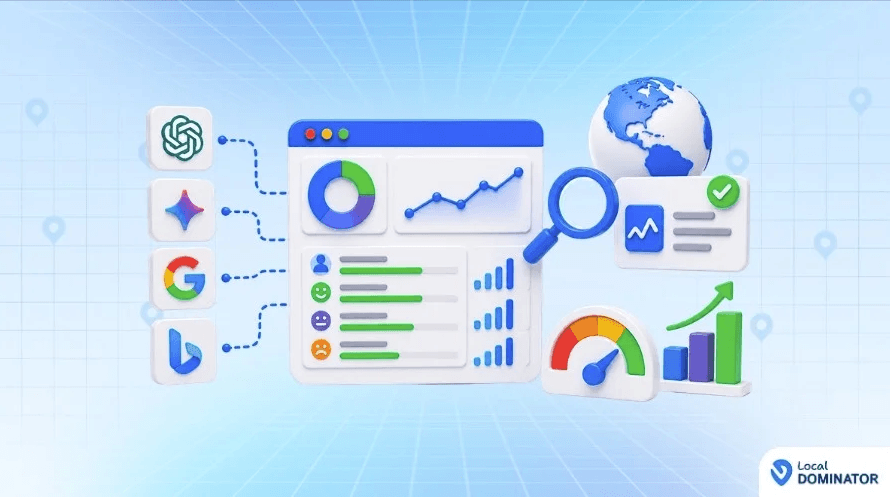
AI Visibility Guide for Auditing Brand Presence in Generative Search

An AI visibility audit is the systematic process of tracking and measuring how your business appears when users query large language models. Instead of checking standard search engine results pages, you evaluate how conversational assistants pull and present your brand data. This process uncovers exactly how often your business is recommended, what context the models use, and where your digital footprint needs strengthening to maintain relevance in modern search.
Conducting a formal audit prepares your brand for the shift toward prompt-based discovery. Traditional search relies on users clicking multiple links, but generative search presents a single, synthesized answer. Understanding your presence within these models ensures that your business does not disappear from the consumer decision-making path. It allows you to protect your market share as AI engines become the primary gateway for information.
Executing this strategy requires a clear framework that covers data collection, metric calculation, and ongoing optimization. This article details how to map your core topics, analyze citations, and track competitor mentions across major platforms. By following this operational workflow, you can turn raw conversational data into an actionable AI visibility guide that improves your overall digital presence.
Structuring Your AI Audit Strategy
You must establish a rigorous framework to extract clear data from conversational engines. A structured strategy ensures that you gather reliable insights before making changes to your website content.
Defining Topics and Search Intent
You begin the process by identifying the core topics and search terms that define your business and industry. Gather up to 10 primary topics that represent your core services, locations, and brand assets. These topics form the foundation of your audit. They ensure that you test the exact phrases that potential customers use when looking for solutions in your market.
Next, you categorize each topic by specific intent types. These include informational intent for users looking to learn, transactional intent for users ready to buy, commercial intent for users comparing options, and navigational intent for users looking for a specific brand. This categorization allows you to automatically generate natural-language prompts. The system uses these intent types to mimic real user questions instead of stiff keyword strings.
This categorization directly impacts your final analysis. By tracking intent, your reports show which phase of the buyer journey your brand dominates and where you are missing. You can see if AI models suggest your business during commercial research or if you only appear for direct brand names. This data guides your content production toward specific funnel gaps.
See also: How Marketing Fuels Sustainable Business Growth
Establishing Baseline Metrics
You must run initial scans across multiple platforms to establish an accurate performance baseline. Your audit should query major models, including ChatGPT, Gemini, Google AI Mode, Perplexity, Claude, and Grok. Testing across all six platforms gives you a complete view of your visibility. It ensures that your optimization strategy is not biased toward a single network.
Manual prompt testing is slow and yields inconsistent results because AI models change constantly. To solve this problem, you can deploy an automated AI tracker to run your custom prompts across all selected engines simultaneously. The automated system reduces manual burden by scanning raw text responses for business mentions, calculating exact placement, and identifying overall sentiment.
The initial scan delivers a baseline visibility score for your brand. This proprietary metric calculates your authority based on mention frequency, ranking position, and engine coverage. Higher positions and positive mentions across all six engines yield a higher score. This baseline acts as your single point of comparison for all future optimization work.
Analyzing Sources and Citations
The next step requires you to isolate the specific links, articles, and citations that AI models use to build their answers. Generative engines rarely create information from scratch. They pull facts from indexed websites, local directories, and press releases. Identifying these sources tells you exactly which external platforms influence the AI’s understanding of your business.
You must cross-reference these discovered sources to verify their accuracy and tone. Check if the AI pulls data from old profiles, inaccurate review sites, or outdated blog posts. If the sources contain errors, the AI will repeat those errors to users. Documenting these links helps you build a clean list of external web properties that require immediate updates or citation corrections.
This analysis yields a comprehensive source metric report. The data highlights which third-party platforms carry the most weight in your industry’s generative search algorithms. You can prioritize your off-page SEO and digital PR efforts based on these facts. Instead of guessing where to build links, you focus on the exact websites that feed the language models.
Measuring and Improving Performance
You use your baseline metrics to find competitive advantages and execute targeted updates. This phase turns raw tracking data into systematic improvements.
Evaluating Competitor Visibility
You must track which businesses the AI models suggest instead of or alongside your brand. The competitor analysis tab logs every business name that appears in the prompt responses. This step reveals your true digital rivals in the AI landscape, which often differ from your traditional search competitors.
The system categorizes these rivals using a strength indicator. Competitors are marked as strong, moderate, or weak based on how frequently they appear across your prompt list. A strong competitor indicates a brand that the AI trusts heavily and references across multiple intent types. Monitoring these patterns shows you who stands between your brand and peak visibility.
You use this competitive intelligence to reverse-engineer their success. By analyzing the digital footprint of strong competitors, you can find the specific directories, media mentions, and structured data they use. Closing these gaps allows you to systematically weaken their hold on the AI responses and capture their visibility.
Implementing AI-Driven Opportunities
When your business does not appear in prompt responses, it means the models lack sufficient indexed data to recommend you. You must look for structural content gaps on your website to solve this problem. The audit reveals which topics lack depth or fail to answer natural-language questions clearly.
You can organize your optimization workflow using automated recommendations. Each opportunity includes a specific priority level and an estimated effort score. This allows you to plan your technical resources efficiently. You can focus on high-priority, low-effort tasks first, such as fixing missing schema markup or updating local citation names.
Execution involves updating your site content, local profiles, and structured data to answer the AI’s needs. You rephrase headings into clear questions and provide direct, factual answers in the body copy. This clean formatting makes it easy for language models to parse, extract, and reference your business in future user queries.
Scheduling Continuous Monitoring
An AI visibility audit is not a single event. Language models update their training data and algorithms constantly, which causes visibility to shift. You must move from a one-time audit to an automated tracking schedule. You can set your campaigns to run automatically on a weekly or monthly cadence depending on your client needs.
Continuous monitoring allows you to use delta indicators and trend graphs. The dashboard compares your current scan against the previous run to highlight changes in mentions, average position, and overall visibility score. These historical visual graphs show whether your content optimizations are successfully earning more real estate over time.
Finally, you can compile these insights into shareable public links. These reports allow you to show transparent progress to stakeholders or agency clients without requiring them to log into a system. Clear tracking proves the return on investment for your optimization efforts and keeps your team aligned on performance goals.Managing digital presence now requires keeping pace with how large language models discover and recommend your brand. By systematically mapping topics, tracking engine responses, and closing content gaps, businesses can protect their digital authority. Local Dominator is a cloud-based Search Everywhere Platform specializing in unified local SEO and AI search tracking for local agencies and businesses. It serves as a single source of truth that integrates SERP analytics and citations to make visibility simple, predictable, and scalable across all digital touchpoints.