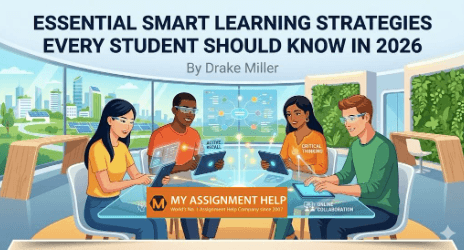
Essential Smart Learning Strategies Every Student Should Know in 2026

The landscape of higher education has undergone a radical, permanent transformation. Moving far beyond the emergency, isolated Zoom sessions of the early 2020s, the modern university experience in 2026 is defined by a deep, seamless integration of advanced technology into everyday learning. Today, being a successful student isn’t about pulling all-nighters at the library, consuming endless energy drinks, or passively highlighting textbooks. Instead, it is about mastering Smart Learning—the deliberate convergence of cognitive science, intentional digital workflows, and advanced technology to achieve academic excellence without the burnout.
For current undergraduate students and high school seniors preparing for the high-stakes transition to higher education, understanding these shifts is critical. If you are still relying on traditional, linear study methods—like re-reading raw notes or cramming a week’s worth of lectures into a single evening—you are working harder, not smarter. In the current academic ecosystem, efficiency is the ultimate currency.
Here are the defining smart learning trends of 2026 that every student must embrace to stay competitive, agile, and academically successful.
1. The Rise of Hyper-Personalized Study Companions
In 2026, generic search engines and basic, conversational chatbots have evolved into hyper-personalized, context-aware AI study companions. These are not shortcuts designed to write essays or bypass critical thinking; rather, they function as 24/7 personal tutors tailored completely to your individual cognitive profile.
Modern AI companions sync securely with your course syllabi, lecture recordings, and digital textbooks. They understand your unique academic strengths and pinpoint your conceptual weaknesses before a professor ever grades a quiz. For instance, if you are a visual learner struggling with organic chemistry, your AI companion can automatically convert dense, text-heavy descriptions of molecular orbital theory into interactive, color-coded 3D models. If you learn better through auditory channels, it can synthesize a custom, podcast-style audio breakdown of your weekly humanities readings while you commute.
While these tools are excellent for real-time tutoring and breaking down complex modules, many students still prefer pairing technology with human expertise for comprehensive research and structured writing support. When deadlines pile up, choosing to purchase essay online at Myassignmenthelp.com remains a trusted way to secure fully researched, syllabus-compliant model papers that keep your grades on track.
How to Leverage This Trend via the Feynman Technique
Instead of using AI to generate passive summaries, turn it into an active interrogation tool. Use your companion to practice the Feynman Technique—a mental model where you explain a complex topic in simple terms to verify your understanding. Input your notes into your study tool and instruct it: “Act as a critical evaluator. I will explain the concept of economic inflation in my own words, and I want you to identify the gaps, assumptions, or inaccuracies in my logic.” This transforms the AI from a mere answering machine into a rigorous cognitive gym.
2. Immersive Education: XR as Standard Academic Infrastructure
Virtual Reality (VR) and Augmented Reality (AR)—collectively known as Extended Reality (XR)—have officially moved out of the gaming realm and into standard university curricula. In 2026, college students don’t just read about historical events or abstract anatomical structures; they actively experience them.
Medical and pre-med tracks use high-fidelity VR headsets to perform mock surgeries with haptic feedback, allowing students to feel the resistance of tissue before stepping into a physical clinical environment. Engineering students test the structural integrity of bridge designs in simulated wind tunnels, experiencing structural failures firsthand without real-world safety hazards. History majors can walk through digitally reconstructed ancient civilizations, interacting with architectural marvels as they existed thousands of years ago.
However, translating these immersive historical experiences into rigorous, well-cited academic papers requires a completely different set of analytical skills. For students struggling to articulate these complex, multi-dimensional perspectives in written assignments, collaborating with a dedicated history essay writing service can help bridge the gap, ensuring that experiential learning is backed by flawless historiographical analysis and proper archival documentation.
The Everyday Student Workflow
Even outside specialized campus labs, affordable AR glasses and mobile applications allow students to project interactive, three-dimensional diagrams right onto their study desks. If you are preparing for a biology exam, you can project a beating human heart above your laptop, isolating specific ventricles or valves with hand gestures. This spatial learning approach significantly accelerates memory encoding, converting abstract definitions into tangible, memorable experiences.
3. Micro-Credentials, Nano-Degrees and the Dual-Track Resume
The traditional four-year bachelor’s degree remains highly valuable, but the global job market in 2026 demands immediate, verifiable, specialized skills. As a result, top-tier students are adopting a hybrid approach to their higher education by pursuing micro-credentials and nano-degrees concurrently with their university degree programs.
Universities worldwide have partnered with tech giants and professional bodies to offer short, modular certificates in high-demand fields like prompt engineering, ethical AI implementation, data visualization, and cloud architecture. These bite-sized credentials take anywhere from six weeks to three months to complete and can be stacked directly onto a traditional résumé.
See also: Practical Tips to Win Catastrophic Injury Lawsuits Effectively
Designing a Strategic Skill Stack
Consider the competitive advantage of a dual-track education. A student graduating with a standard major in Business Administration is competing with thousands of identical degrees. However, a student who graduates with a major in Business Administration coupled with distinct micro-credentials in Python Programming and Data Analytics stands out instantly to corporate recruiters. It proves to prospective employers that you possess both macroscopic theoretical knowledge and microscopic operational execution skills.
4. Neurodiversity-Informed and Accessible Learning Tech
The modern digital classroom is built on the foundation of radical inclusivity. In 2026, assistive technologies have completely shed their stigma and become mainstream productivity tools that benefit all students, particularly those who are neurodivergent—such as students navigating ADHD, dyslexia, visual processing differences, or executive dysfunction.
Smart learning management platforms now feature built-in, highly customizable cognitive support systems designed to optimize focus and comprehension:
- Bionic Reading Modes: This technique bolds the first few letters of words, letting the eye glide through text smoothly while maintaining high comprehension. It dramatically accelerates reading speeds for dyslexic students and reduces cognitive fatigue during long research sessions.
- Smart Focus Blockers: AI-driven applications analyze your real-time attention spans. When they sense your cognitive load is high or your attention is fracturing, they dynamically alter your digital environment—muting non-essential notifications, hiding distracting browser tabs, and curating spatial audio playlists designed to induce a deep flow state.
- Automated Live Transcription & Summarization: Real-time, highly accurate speech-to-text tools process university lectures instantly. This allows students to stop frantically typing every word a professor says and instead focus entirely on listening, processing, and participating in class discussions, knowing a pristine, structured set of notes is being generated automatically in the background.
5. Gamified Productivity Ecosystems and the Leitner System
The days of staring blankly at standard, handwritten paper flashcards are over. In 2026, student productivity has been thoroughly gamified, treating academic progression like an immersive role-playing game (RPG).
Students track their study hours, assignment milestones, and reading targets within platforms where completing tasks earns experience points (XP), unlocks digital rewards, and builds accountability streaks. This gamified approach turns the often isolated experience of studying into an engaging, progressive habit loop that triggers positive dopamine feedback loops.
Integrating the Leitner System for Long-Term Retention
To maximize these digital ecosystems, smart students map their revision schedules to the Leitner System—a highly efficient method of spaced repetition.
In this setup, digital flashcards are sorted into distinct boxes based on how well you know the material. Cards in Box 1 are reviewed every day, while cards in Box 3 or 4 might only be reviewed once a week. When you answer a card correctly, it moves to the next box; get it wrong, and it returns to Box 1. Gamified apps automate this entire process, prompting you to review specific cards at the exact moment your brain is about to forget them, ensuring flawless retention for midterms and finals with half the study time.
6. Embracing External Academic Support Ecosystems for Scaffolding
As university curricula become faster-paced and multi-disciplinary, the ability to manage time effectively has become a student’s greatest strategic asset. Smart learners recognize that they do not have to struggle through highly complex coursework entirely on their own, nor do they view asking for assistance as a sign of weakness. Instead, utilizing external expertise has become a normalized, proactive strategy for maintaining a high GPA and managing executive stress.
When facing overlapping deadlines, highly complex research methodologies, or intricate data analysis, top-performing students treat specialized academic support platforms as professional consultants. Myassignmenthelp.com allows students to access expert academic guidance, structured subject-matter samples, and precise editing services.
Rather than treating these external services as a shortcut, successful students use them as educational scaffolding. When a student receives an expertly structured sample or code repository, they break down the methodology, analyze the source citations, and use it as a blueprint to elevate their own academic writing and technical problem-solving skills. This proactive approach ensures that students can master difficult material efficiently, beat severe deadline bottlenecks, and maintain total control over their academic trajectory.
7. Intelligent Predictive Analytics for Time Management
One of the most persistent drivers of university burnout has always been poor time management. In 2026, predictive analytics tools have systematically dismantled this problem by removing the guesswork from a student’s calendar.
Integrated smart calendars don’t just sit passively waiting for you to add events; they actively analyze your past academic performance, reading speed, writing habits, and the historical difficulty level of specific university courses. When a syllabus drops and a professor assigns a 12-page research paper due three weeks down the line, the predictive software takes over.
It does not simply slap the final deadline on your screen. Instead, it maps out a customized, incremental daily schedule based on your historical data. It alerts you exactly when you need to begin initial literature reviews, when to draft your thesis statement, and precisely how many hours you need to dedicate each afternoon, adapting dynamically if you fall behind or get ahead. This shift from reactive panic to predictive execution ensures that students can maintain a healthy work-life-study balance.
8. Continuous Skill-Mapping and the Evolution of the Digital Portfolio
The traditional, static one-page paper résumé is rapidly losing its crown to the dynamic, live-updated digital portfolio. In 2026, smart learning management systems continuously track and verify the practical skills a student demonstrates across every assignment, case study, lab report, and presentation they submit.
Every time you write a comprehensive marketing strategy, write a functional, bug-free software script, or compile an advanced statistical analysis, the performance data is automatically pushed to a live skill-map. This map visualizes your growing professional expertise in real-time.
When applying for competitive internships or entry-level roles, students no longer simply list generic, unsubstantiated bullets like “proficient in Python” or “strong technical writer.” Instead, they share a secure link to their interactive portfolio. This portfolio links recruiters directly to verified, anonymized examples of their actual academic work, proving their capabilities instantly and bypassing traditional entry-level gatekeeping.
Summary of Smart Learning Strategies for 2026
| Trend | Core Benefit to Students | Actionable Implementation |
| AI Study Companions | Tailored explanations, cognitive gap analysis, and active recall. | Pair your tool with the Feynman Technique to spot logic gaps. |
| Immersive XR Tech | Translates abstract concepts into interactive 3D structures. | Use AR mobile applications to project anatomical or structural models. |
| Micro-Credentials | Builds immediate, job-market-ready skills alongside a major. | Stack specialized industry certificates onto your traditional degree path. |
| Academic Support Tools | Alleviates deadline bottlenecks and provides structural scaffolding. | Myassignmenthelp.com to dissect complex methodologies. |
| Predictive Analytics | Mitigates academic burnout through automated scheduling. | Rely on smart calendars to break large projects into minor daily habits. |
Frequently Asked Questions
Q.1 What is “Smart Learning” compared to traditional studying?
Traditional studying often relies on passive learning methods, such as re-reading textbooks, highlighting text, or cramming right before an exam. Smart Learning utilizes cognitive science frameworks (like spaced repetition and active recall) integrated with digital tools (like predictive analytics calendars and AI study companions) to maximize retention and minimize study hours.
Q.2 Is using an AI study companion considered academic dishonesty?
No, provided it is used as an educational aid rather than an automated shortcut. Using AI to generate content, write essays, or solve exams for you violates academic integrity policies. However, using AI to build mock quizzes, explain highly complex topics using the Feynman Technique, or provide interactive 3D structures is an accepted, proactive study workflow.
Q.3 How do micro-credentials differ from a traditional college major?
A college major offers a broad, comprehensive theoretical foundation in a specific discipline over a four-year period. A micro-credential or nano-degree is a highly targeted, skills-focused program (lasting weeks to months) that verifies proficiency in a single high-demand operational skill, such as Python or cloud architecture. Combining both creates a highly competitive resume.
Q.4 How can Myassignmenthelp.com improve my long-term grades?
Top-performing students use external support platforms for academic scaffolding. By analyzing professionally structured samples and editing notes, students can study proper research methodologies, citation styles, and analytical frameworks. This structural blueprint helps students elevate their own academic writing and technical problem-solving.
Q.5 What is the Leitner System, and how does it help with memory retention?
The Leitner System is a structured method of spaced repetition using flashcards. Cards are grouped into boxes according to how well you understand the material. Cards you know poorly are reviewed daily, while cards you know well are reviewed weekly. Digital gamified platforms automate this tracking, promoting long-term neural memory retention with significantly less effort.
Conclusion: Driving Your Own Academic Autonomy
The ultimate objective of smart learning in 2026 is absolute student autonomy. The technological advancements, cognitive frameworks, and support ecosystems available today are engineered to give high school and college students complete control over how, when, and where they acquire knowledge.
Technology alone, however, is not a silver bullet. True academic success in this modern era belongs entirely to the students who intentionally leverage these trends—combining AI companions, spaced repetition systems, external academic scaffolding, and predictive planning to build a highly optimized, stress-free educational journey. By adopting these smart trends today, you aren’t just preparing to pass your upcoming exams; you are building the exact digital fluency, agile mindset, and deep work habits required to thrive in the future workforce.
About the Author – Drake Miller
I am a dedicated content writer at Myassignmenthelp.com, known for developing informative and student-focused educational blogs. His content mainly highlights academic support, assignment writing strategies, study techniques and emerging trends in higher education. Through his engaging articles, he strives to help students improve their learning experience, manage academic tasks effectively and achieve better educational outcomes.