Drug Screening Has Become Quietly Routine in Safety-Sensitive Industries (Here’s What That Looks Like Now)

Workplace drug screening used to be controversial. Twenty years ago it was a topic of active debate in HR circles, legal commentary, and employee advocacy. The arguments cut both ways. There were privacy concerns. There were accuracy concerns. There were cost concerns. There were questions about what kinds of jobs justified what kinds of testing.
That debate hasn’t disappeared, but it has narrowed. The 2026 landscape has settled into a relatively stable consensus about which industries test, what they test for, and how. Safety-sensitive industries (transportation, construction, manufacturing, healthcare, oil and gas, energy production) test as a default. Office and knowledge-work industries mostly don’t, except for specific federal contractor situations. Cannabis legalisation in many states has shifted what gets tested for and how positives get handled, but it hasn’t reduced the overall volume of testing in safety-sensitive roles. It has, if anything, made the operational discipline around testing more important.
For employers in safety-sensitive industries, drug screening is now a routine operational process rather than a discretionary policy choice. The insurance underwriting environment makes it mostly non-optional. The OSHA compliance environment reinforces it. The actual mechanics of running a program are well-established.
A few things that have changed in the operational reality of workplace screening in the last few years:
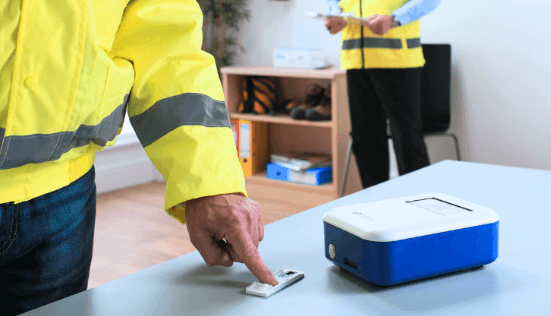
Instant-result kits have become the default for pre-employment and post-incident testing. Lab-only testing still happens for confirmation of non-negative results and for some regulated industries’ random testing, but the front-line testing is increasingly done with CLIA-waived instant kits that produce results in 5 to 10 minutes. This compresses the hiring cycle and makes post-incident testing actually meet its required 8-hour window without scrambling.
12-panel screens have largely replaced 5-panel as the standard. The federal SAMHSA 5-panel still has its place for some regulated industries, but the gap between what it covers and what actually shows up in impairment cases has driven most non-DOT employers to the broader 12-panel screen. Adding fentanyl to the panel is now common in any safety-sensitive context given the prevalence in counterfeit pills.
Suppliers like 12 Panel Now have made the supply chain side of screening programs more predictable. Pricing has stabilised. Inventory is more reliable. Documentation (chain of custody forms, MRO referral processes) comes integrated rather than bolted on. For a safety-sensitive employer running a program at any meaningful scale, the supplier reliability question has gotten easier.
Random testing has become standard in safety-sensitive contexts. Most insurance underwriters now expect to see documented random testing programs at policy renewal, not just pre-employment screening. The expectation is typically a random selection rate around 25 percent annually for safety-sensitive positions. Some industries (aviation, certain DOT-regulated transportation) have specific federally mandated rates that are higher.
Cannabis-specific policy adjustments have evolved. In states where recreational cannabis is legal, the question of how to handle a positive THC result has gotten more nuanced. Most safety-sensitive employers still treat positive THC as disqualifying for the safety-sensitive role specifically, but several states now require accommodation considerations for non-safety-sensitive contexts. The policy needs to be specific and the legal review needs to be current with the state environment.
A few operational practices that distinguish well-run screening programs from poorly-run ones:
The chain of custody is bulletproof. Every test has documented chain of custody from collection through result. The forms are filed correctly. The signatures are present. If the program is ever audited or a test result is ever disputed, the documentation tells a clean story.
See also: Health, Fitness and clothing items about Sauyr Zhotasy
Medical Review Officer involvement is consistent. Every non-negative result goes to an MRO who reviews and rules out legitimate prescription explanations. The MRO step is what makes positive test results legally defensible. Programs that skip it lose challenges they shouldn’t lose.
Supervisor training is current. The supervisors who initiate reasonable-suspicion testing are trained on what reasonable suspicion looks like, how to document it, and what to do (and not do) in the conversation with the employee. Untrained supervisors are the source of most for-cause testing problems.
Post-incident protocol triggers automatically. Any qualifying incident triggers the testing process without supervisor discretion. The 8-hour window is short. Discretion creates delays. Automatic triggers don’t.
Recordkeeping is centralised. All test results, MRO reviews, return-to-duty processes, and random selection logs are kept in one place, with appropriate confidentiality protections. The recordkeeping is what survives audit and what defends the employer in any subsequent legal challenge.
The shift in safety-sensitive industries over the last few years isn’t really about more testing. The volume of testing hasn’t grown dramatically. The change is in how seriously the operational discipline is taken. The employers who treat screening as a checkbox compliance task tend to have problems when they get audited or when a positive result gets challenged. The employers who treat it as a real operational program with documented processes, trained staff, reliable suppliers, and proper MRO involvement tend to have boring, uneventful programs that quietly do their job year after year.
For a safety-sensitive employer building or upgrading a screening program right now, the operational pieces are well-understood. The supply chain is mature. The legal framework is stable in most states. The insurance pressure makes the business case obvious. What separates the programs that work from the programs that don’t is execution consistency, not strategic insight. Pick a reliable supplier. Use a 12-panel screen as the standard. Document everything. Train the supervisors. Use an MRO. Run random testing at the rate your insurance expects. Don’t skip steps. The program will do what it needs to do.